Monday, December 13, 2010

Oh No I Being Sucked into a Black Hole
Okay I'm assuming that most of you know nothing about black holes. Okay what we are going to discuss in this blog is what black holes are and where they come from and what they look like. First we'll discuss what black holes are. A black hole is the next stage for enormous stars unlike the Sun. Black holes form when a star is out of nuclear fuel which it needs to exist. It grows smaller and smaller until it collapses under its own weight. The truth is nobody really knows what a black hole looks like because they're invisble to a human eye and there impossible to see.
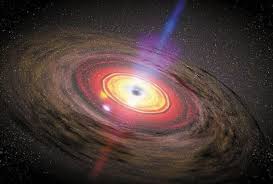
Obviously, If you got sucked into one you would probably be pulled by your feet faster then your head. You would probably be stretched like a piece of spaghetti.

According to Einstein's theories of relativity,nothing can travel faster than the speed of light. Therefore once something gets sucked by a black hole obviously you can never be released or get out.

The black hole emitts or sends no light due to its extremely powerful gravitational pull. Planets, light,and other matter must pass close to a black hole in order to be pulled into its grasp. Black holes are small in size because they're so small distant,and dark,black holes cannot be directly observed. Black holes are shaped like a sphere and they can spin. Astronomers believe that one black hole is born every day. Okay I'm going to conclude this blog with a video of black holes obviously. Chao! Peace Out!
Monday, December 6, 2010
Friday, December 3, 2010
Sun
In this blog we're going to discuss what kind of energy the Sun contains. We're also going to discuss what the Sun is made of. We're also going to discuss the layers of the Sun. First we're going to discuss what kind of energy the Sun contains and what the Sun is made of. The Sun is of course a star. The Sun is yellow obviously. You should already know that the Sun is contains solar energy. The Sun is made up of hydrogen and helium.

Now we're going to discuss the layers of the Sun. The first layer is the photosphere which means"the sphere of light". The next layer is called the chromosphere. Above the cromosphere is the corona. The word corona comes from the latin word for crown. Then another layer is called connective or convection zone. The core is in the center of the earth. Most of the fusion takes place in the core. Energy created in the core moves outward. It passes next through the radiative or radiation zone.The energy from the core heats this zone. This zone is less dense then the core. Okay guys I hope you enjoyed my blog. Now I'm going to conclude this blog with a video.
Now we're going to discuss the layers of the Sun. The first layer is the photosphere which means"the sphere of light". The next layer is called the chromosphere. Above the cromosphere is the corona. The word corona comes from the latin word for crown. Then another layer is called connective or convection zone. The core is in the center of the earth. Most of the fusion takes place in the core. Energy created in the core moves outward. It passes next through the radiative or radiation zone.The energy from the core heats this zone. This zone is less dense then the core. Okay guys I hope you enjoyed my blog. Now I'm going to conclude this blog with a video.
Monday, November 29, 2010
Thursday, November 18, 2010
Stars Oh Stars!
 Oh my god just look at those stars. Sorry that just me admirimg stars. There beautiful aren't they. What you are going to learn is about stars. What you are going to learn is what stars are. Stars are giant balls of gass held together by gravity. There are three kinds of stars like red,blue,and yellow. The blue ones are the hottest which of coarse are the prettiest to me. I'm assuming that everybody has a different opion. Red stars are the coolest. You think that the red ones would be the hottest but nope they're the coolest.The yellow stars are a little bit hotter. The sun is yellow obviously. In fact stars are made from a cloud of gases and dust called a nebula.What you are going to learn now are the stages of a star. The first stage of a star is the protostar also known as stellar nursery. The second stage of a star is the main sequence. Our Sun is in the main sequence. The main sequence stage is where a star lives the longest. The third stage is the red giant. This is the Sun's next stage. When this part of the Sun's life occurs the Sun will become cooler and we would probably die instantly but don't worry we will probably be long dead by then.The last stage is the white dwarf .When large stars get old, they explode into a supernova and when small stars get old, they become a white dwarf. The way to do that is to conclude this blog with a video from you tube. I hope you enjoy my video.Sorry that the video is above the blog entry instead of being below the blog entry. Well I hope you enjoyed my blog entry. Chao! Peace out!
Monday, November 15, 2010
Memories from the trip
I remember on Saturday, before we left, I found out that the the trip was prosponed to Tuesday because we were originally supposed to leave on Monday. The only reason that the trip was prosponed is because the launch was prosponed to Wednesday and we were originally supposed to leave on Wednesday so yeah. The trip was prosponed like several times like first of all the launch was originally scheduled on Tuesday then they prosponed it to Wednesday. Then they prosponed it to Thursday at 3:30. Well first of all we were going to leave Thursday morning but then the teachers tried to work it out with our parents so we can go see the launch but then it got proponed again to Friday which really sucks because the only reason why I wanted to go on the trip in the first place was so I could see a space shuttle launch. I was really disappointed that it was prosponed because this was the last space shuttle launch ever and I might not be able to see one ever again. Now you see my disappointment.
First of all we stayed at a retreat center called St. Stephen Christen Retreat Center. The reason we stayed at a retreat center is because it was cheaper to stay at a retreat center then it was to stay at a hotel. When we got to the retreat center, I was kind of scared because I saw these people that were Arabs and were all dressed up with this white cover covering their whole entire body. Scary huh!

On Tuesday, the day we got there,we went to the Kennedy Space Center and I remember when they wouldn't let me enter the Kenedy Space Center because they didn't have enough tickets to let everybody go so we had to wait there for like 30 minutes and finally let us in. During the time we were at the Kennedy Space Center, we saw a imax movie. It was so awesome. We got to use 3D glasses and everything was in 3D and everthing. It was just awesome. Then we went to the gift shop and I bought, a mug for my father, a tee-shirt for myself, a rocket, and a keychain for my father. I also remember back at the retreat center there was a lack of channels. They had this kids channel that was very retarded. That show is for like toddlers or something.

On Wednesday we went to the beach and we built sandcastles. I also went in the water with my shorts on.

I remember being in the bus with Duncan, this kid in fourth grade and he told me that it took him 2 years to read a chapter in a book. After that I was trying to avoid him and stay away from him because I don't like dumb kids. I also remember when we played freeze tag and Mrs. Crimminger was it and she tripped on Anabel's ankle which caught a lot of publicity. Okay everybody that was my trip toTitusville,FL. I hope you enjoyed my blog. Chao! Peace!
Friday, November 12, 2010
Oh! No! Help! I'm Floating into Space
What you are going to learn about what gravity is and where it came from. The theory of gravity was discovered by a scientist named Sir Issac Newton. Apparently when he was reading a book in his home, he looked out his window and he saw an apple fall out of his apple tree in his garden. Then Issac wondered what was that mysterious force that caused that apple to fall out of the tree. He knew there must of been some force that keeps the planets in orbit. So Sir Issac Newton called that mysterious force gravity. Gravity is a force that pulls bodies of mass together. Without gravity we wouldn't even exist,nothing would exist to tell you the truth. In fact Sir Issac Newton invented calculus.Did you know that Sir Issac Newton invented the reflecting telescope. In fact the larger the mass the more gravity. According to Sir Issac Newton everything is affected by gravity. According to Sir Issac Newton, gravity is based on mass and distance. Okay guys,I hope you guys enjoyed my blog.Chao! Peace out!

Tuesday, October 19, 2010
Oh!! No!! it's a Tsunami
A tsunami is a series of seismic waves. Tsunami means "harbor wave". Most people refer a tsunami as a big monster wave.What we are going to learn is how they're formed. Most tsunamis at about 80% occur around the Ring of Fire. Tsunamis may also be caused by underwater landslides or volcanic eruptions. Tsunamis race across the sea at up to 500 miles (805 kilometers) an hour—about as fast as a jet airplane. Fast Huh!
The best defense against any tsunami is early warning that allows people to seek higher ground. The Pacific Tsunami Warning System, a coalition of 26 nations headquartered in Hawaii, maintains a web of seismic equipment and water level gauges to identify tsunamis at sea. Similar systems are proposed to protect coastal areas worldwide. Okay guys we are going to take a break. Why won't you listen to my video.

Okay we're back with tsunamis.
A tsunami’s trough, the low point beneath the wave’s crest, often reaches shore first. When it does, it produces a vacuum effect that sucks coastal water seaward and exposes harbor and sea floors. This retreating of sea water is an important warning sign of a tsunami, because the wave’s crest and its enormous volume of water typically hit shore five minutes or so later. Recognizing this phenomenon can save lives. Okay that's it guys. Peace out y'all.
The best defense against any tsunami is early warning that allows people to seek higher ground. The Pacific Tsunami Warning System, a coalition of 26 nations headquartered in Hawaii, maintains a web of seismic equipment and water level gauges to identify tsunamis at sea. Similar systems are proposed to protect coastal areas worldwide. Okay guys we are going to take a break. Why won't you listen to my video.
Okay we're back with tsunamis.
A tsunami’s trough, the low point beneath the wave’s crest, often reaches shore first. When it does, it produces a vacuum effect that sucks coastal water seaward and exposes harbor and sea floors. This retreating of sea water is an important warning sign of a tsunami, because the wave’s crest and its enormous volume of water typically hit shore five minutes or so later. Recognizing this phenomenon can save lives. Okay that's it guys. Peace out y'all.
Wednesday, September 29, 2010
WHAT! VOLCANOS WHAT!!!
The differences between volcanoes that form where plates diverge and volcanoes that form where Earth's plates slide past each other is that when the volcanoes form where the Earth's plates diverge the plates are spreading apart as with the volcanoes that have plates that are sliding past each other that means that they're subducting. As you probably know convergent means that the plates are colliding and divergent means that the plates are spreading apart. You guys probably know that a hot spot is where most volcanoes occur at about 70%. A transform fault boundry is where two plates grind past each other along what are called strike-slip faults. As you probably know is that a continental plate is a plate that collides with another oceanic plate and a continental plate is when a continental collides with another continental plate. A oceanic plate is a plate that collides with another continental plate. As you probably know composite volcanoes are the most explosive type of volcanoes. Cinder cone volcanoes are the most common type. Shield volcanoes are dormant which means that they're non-explosive and gentle. A hotspot is when lava rises in between the plate boundries. Did you know that Cruzo Wilson was the first person to suggest the hotspot theory in 1963. Well I hope that you guys liked my blog and if you are'nt following my blog already than please do. So why don't you check out my video called the volcano song.

Friday, September 24, 2010
WHAT SIMALIARITIES AND DIFFERENCES WHAT!!!!!!!!!
As you probably know or don't know is that there are three types of volcanoes not four three but wait there's more you can't just know the three types of volcanoes are you also have to know the similarities,differences and what they are.
SHIELD VOLCANOES:
A shield volcano is a volcano that is layered with harden basalts. It has a quiet eruptionand is usualy errupting near hawaii.Shield volcanoes are less dangerous then others.
A shield volcano may be described as a volcano with a wide base andwirdsloping sides.
A shield volcano is a volcano with shallow-sloping sides. Shield volcanoes are formed from fluid lava that can travel long distances across slight inclines, resulting in their relatively flat, broad profile. In contrast, steeply sloped stratovolcanoes better match the popular stereotype of a volcano.
Some of the largest volcanoes on earth are shield volcanoes.
This picture below is a picture of a shield volcano.

COMPOSITE VOLCANOES:
Stratovolcanoes also known as composite volcanoes are the most explosive and the most deadliest type of volcano. Stratovolcanos are formed by alter.Stratovolcanoes form are quite impressive, snow-capped peaks which are often exceeding 2500m in height, 1000sq.km in surface, and 400km3 in volume. nating layers of lava and rock fragments. This is the reason they are called composite volcanoes. This is usually caused by viscous magma. When very viscous magma rises to the surface, it usually clogs the craterpile, and gas in the craterpipe gets locked up. Therefore, the pressure will increase resulting in an explosive eruption.

CINDER CONE VOLCANO:
As you probably know cinder cone volcanoes are the most common type. The reason it is called a cinder cone volcano because it is known for it's cone shaped base. It is formed from volcanic fragments and is very steep sided, although not always extremely tall. They usually becoming have just one main vent, and can also sometimes form from a vent of a larger volcano, growing a whole new volcano.
SHIELD VOLCANOES:
A shield volcano is a volcano that is layered with harden basalts. It has a quiet eruptionand is usualy errupting near hawaii.Shield volcanoes are less dangerous then others.
A shield volcano may be described as a volcano with a wide base andwirdsloping sides.
A shield volcano is a volcano with shallow-sloping sides. Shield volcanoes are formed from fluid lava that can travel long distances across slight inclines, resulting in their relatively flat, broad profile. In contrast, steeply sloped stratovolcanoes better match the popular stereotype of a volcano.
Some of the largest volcanoes on earth are shield volcanoes.
This picture below is a picture of a shield volcano.
COMPOSITE VOLCANOES:
Stratovolcanoes also known as composite volcanoes are the most explosive and the most deadliest type of volcano. Stratovolcanos are formed by alter.Stratovolcanoes form are quite impressive, snow-capped peaks which are often exceeding 2500m in height, 1000sq.km in surface, and 400km3 in volume. nating layers of lava and rock fragments. This is the reason they are called composite volcanoes. This is usually caused by viscous magma. When very viscous magma rises to the surface, it usually clogs the craterpile, and gas in the craterpipe gets locked up. Therefore, the pressure will increase resulting in an explosive eruption.
CINDER CONE VOLCANO:
As you probably know cinder cone volcanoes are the most common type. The reason it is called a cinder cone volcano because it is known for it's cone shaped base. It is formed from volcanic fragments and is very steep sided, although not always extremely tall. They usually becoming have just one main vent, and can also sometimes form from a vent of a larger volcano, growing a whole new volcano.
Friday, September 17, 2010
Why!! Why are are some volcanoes quiet and violent? Why!!
Hello, if you don't know how some volcanoes could be violent or quiet , then you should read this blog RIGHT NOW! Okay as you probably now that all volcanoes are not all alike. You know that some eruptions are quiet with lava slowly oozing from a vent and that other eruptions are very violent with lava and other materials being hurled hundreds of miles into the air. Gases from within the earth's interior mix with huge quantities of dust and ash and rise into the air as great dark clouds that can be seen from many kilometers away. Explosive eruptions are caused when lava in the vents hardens into rock and steam and lava builds under the rocks.

When the pressure of the steam and new lava becomes great, a violent explosion occurs. When pressure builds up, eruptions occur. Gases and rock shoot up through the opening and spill over or fill the air with lava fragments. Volcanic eruptions have been known to knock down entire forests. An erupting volcano can trigger tsunamis, flashfloods, earthquakes, mudflows and rockfalls. Why won't check out my video called Volcanoes erupting on the Big Island of Hawaii.
When the pressure of the steam and new lava becomes great, a violent explosion occurs. When pressure builds up, eruptions occur. Gases and rock shoot up through the opening and spill over or fill the air with lava fragments. Volcanic eruptions have been known to knock down entire forests. An erupting volcano can trigger tsunamis, flashfloods, earthquakes, mudflows and rockfalls. Why won't check out my video called Volcanoes erupting on the Big Island of Hawaii.
Monday, September 13, 2010
Friday, September 3, 2010
Tuesday, August 31, 2010
plate tectonics and continental drift
Hey you have reached Science Rocks. If you think this blog is boring please turn your computor off now.
According to the theory of continental drift, the world was made up of a single continent through most of geologic time. That continent eventually separated and drifted apart, forming into the seven continents we have today. The first comprehensive theory of continental drift was suggested by the German meteorologist Alfred Wegener in 1912. The hypothesis asserts that the continents consist of lighter rocks that rest on heavier crustal material—similar to the manner in which icebergs float on water. Wegener contended that the relative positions of the continents are not rigidly fixed but are slowly moving—at a rate of about one yard per century.
According to the generally accepted plate-tectonics theory, scientists believe that Earth's surface is broken into a number of shifting slabs or plates, which average about 50 miles in thickness. These plates move relative to one another above a hotter, deeper, more mobile zone at average rates as great as a few inches per year. Most of the world's active volcanoes are located along or near the boundaries between shifting plates and are called plate-boundary volcanoes.
According to the theory of continental drift, the world was made up of a single continent through most of geologic time. That continent eventually separated and drifted apart, forming into the seven continents we have today. The first comprehensive theory of continental drift was suggested by the German meteorologist Alfred Wegener in 1912. The hypothesis asserts that the continents consist of lighter rocks that rest on heavier crustal material—similar to the manner in which icebergs float on water. Wegener contended that the relative positions of the continents are not rigidly fixed but are slowly moving—at a rate of about one yard per century.
According to the generally accepted plate-tectonics theory, scientists believe that Earth's surface is broken into a number of shifting slabs or plates, which average about 50 miles in thickness. These plates move relative to one another above a hotter, deeper, more mobile zone at average rates as great as a few inches per year. Most of the world's active volcanoes are located along or near the boundaries between shifting plates and are called plate-boundary volcanoes.
Thursday, August 26, 2010
Mount Everest
Everest was formed about 60 million years ago.Did you know that Mount Everest is 29,035 (8850m)-found to be 6' higher in 1999.

On May 29, 1953, Sir Edmund Hillary, attemtted to make the first assent to the South Col Route.
On Aug. 20,1980, Reinhold Messner, IT, attemtted to make the first solo assent from the NE Ridge to North Face.
On Feb. 17,1980, L.Cichy and K. Wielicki, attemtted to make the first winter assent.
Mt. Everest rises a few milimeters each year due to geological forces.
Sir George Everest was the first person to record the height and location of Mt. Everest.
May 8, 1978- Reinhold Messner, IT, and Peter Habeler were the first people to make the first oxygenless asssent, AUT, via the South-East Ridge.
On May 25,1996, Cathy O'Dowd was the first woman to reach the summit of Mount Everest from both north and south sides.
On May,22,2001, Temba Tsheri became the youngest person to climb Mount Everest.
On May,25,2001 Sherman Bull became the oldest person to climb Mount Everest.
May,25,2001, Erik Weihenmeyer became the first blind person to climb Mount Everest.
On May, 24, 2000 , Appa Sherpa became the first person to climb Everest 11 times.
Babu Chiri Sherpa made the record for the longest stay at the summitt which was 21 hours and a half
In 1988, Jean-Marc Boivin of France descended from the top in just 11 minutes, paragliding.

You probably know that Mount Everest was named after Sir George Everest in 1865 ,the British surveyor-general of India. Mount Everest used to be known as Peak 15.
On May 29, 1953, Sir Edmund Hillary, attemtted to make the first assent to the South Col Route.
On Aug. 20,1980, Reinhold Messner, IT, attemtted to make the first solo assent from the NE Ridge to North Face.
On Feb. 17,1980, L.Cichy and K. Wielicki, attemtted to make the first winter assent.
Mt. Everest rises a few milimeters each year due to geological forces.
Sir George Everest was the first person to record the height and location of Mt. Everest.
May 8, 1978- Reinhold Messner, IT, and Peter Habeler were the first people to make the first oxygenless asssent, AUT, via the South-East Ridge.
On May 25,1996, Cathy O'Dowd was the first woman to reach the summit of Mount Everest from both north and south sides.
On May,22,2001, Temba Tsheri became the youngest person to climb Mount Everest.
On May,25,2001 Sherman Bull became the oldest person to climb Mount Everest.
May,25,2001, Erik Weihenmeyer became the first blind person to climb Mount Everest.
On May, 24, 2000 , Appa Sherpa became the first person to climb Everest 11 times.
Babu Chiri Sherpa made the record for the longest stay at the summitt which was 21 hours and a half
In 1988, Jean-Marc Boivin of France descended from the top in just 11 minutes, paragliding.
Friday, August 20, 2010
The first helicopters
 This helicopter, designed by George De Bothezat and Ivan Jerome, made its first public flight on December 18, 1922, at McCook Field near Dayton, Ohio.
_medevac_inflight_bw.jpg)
This helicopter, built by Etiénne Oehmichen, had four lifting airscrews and five auxiliary propellers. It set flight records in 1924.
 In Etiénne Oehmichen's first attempt at vertical flight, around 1920, he built a twin-rotor helicopter that had insufficient power to fly. He solved the problem by adding a balloon to the machine.
Subscribe to:
Comments (Atom)